
Check your service line in 3 steps
The City needs each resident and homeowner to identify the material of their service line. It takes three steps:
- Step 1Search My AddressSearch your address on the map.Inventory map · ArcGIS (outside website, opens in a new tab)
- Step 2Identify My PipeIdentify your pipe material with the guide.Identification guide · ArcGIS StoryMaps (outside website, opens in a new tab)
- Step 3Submit My ResultsReport it with the survey.Service line survey · Jotform (outside website, opens in a new tab)
These links open outside websites in a new tab. Questions? Email leadserviceline@paris.ky.gov.
The City Needs Your Help
The best way to complete this inventory is for each resident and homeowner to identify the material of their service line. Your line may be made of plastic. It also may be made of lead, copper, or galvanized steel.
In compliance with the EPA's Revised Lead and Copper Rule, the City of Paris is developing an inventory of the materials used for water service lines in the communities we serve. Search your address in the map to learn whether your property might have a lead service line, or a galvanized line that could contain lead. If the material is unknown, a material verification survey can help you determine whether the portion you own is lead, galvanized steel, copper, or plastic. When you have completed the visual inspection, email your results to leadserviceline@paris.ky.gov.
What Your Pipe Looks Like
Text version
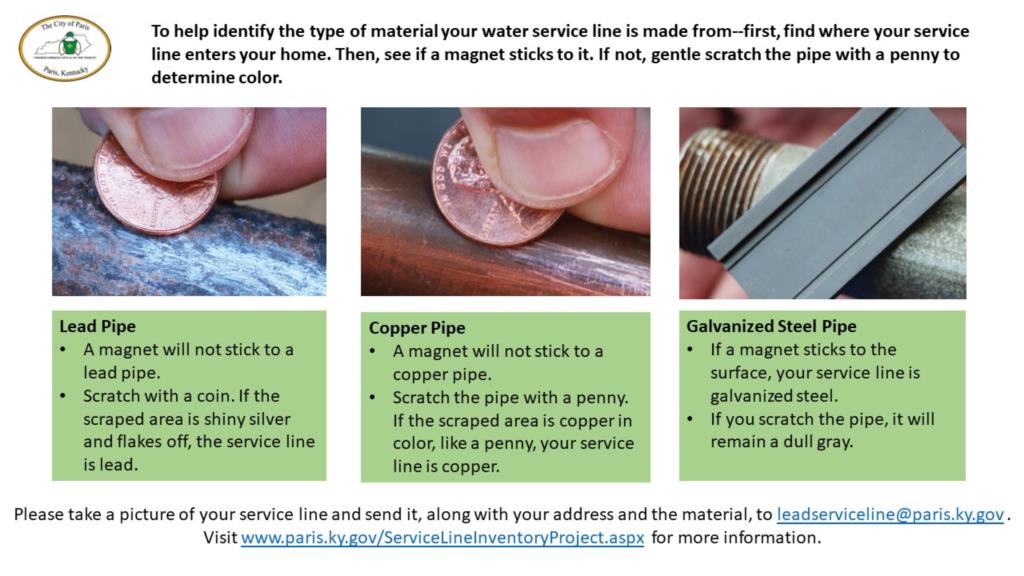
To help identify the type of material your water service line is made from--first, find where your service line enters your home. Then, see if a magnet sticks to it. If not, gentle scratch the pipe with a penny to determine color.
Lead Pipe: A magnet will not stick to a lead pipe. Scratch with a coin. If the scraped area is shiny silver and flakes off, the service line is lead.
Copper Pipe: A magnet will not stick to a copper pipe. Scratch the pipe with a penny. If the scraped area is copper in color, like a penny, your service line is copper.
Galvanized Steel Pipe: If a magnet sticks to the surface, your service line is galvanized steel. If you scratch the pipe, it will remain a dull gray.
Please take a picture of your service line and send it, along with your address and the material, to leadserviceline@paris.ky.gov.
Text version
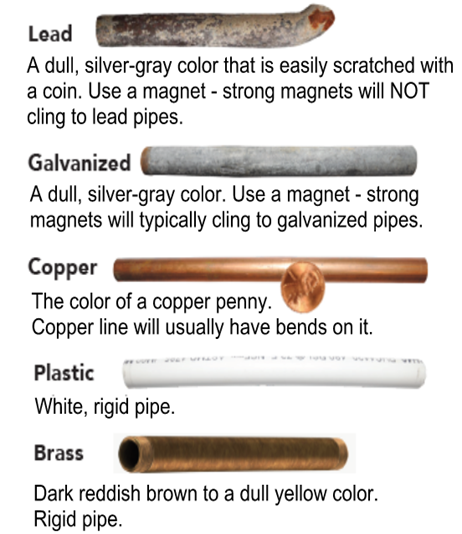
Lead: A dull, silver-gray color that is easily scratched with a coin. Use a magnet - strong magnets will NOT cling to lead pipes.
Galvanized: A dull, silver-gray color. Use a magnet - strong magnets will typically cling to galvanized pipes.
Copper: The color of a copper penny. Copper line will usually have bends on it.
Plastic: White, rigid pipe.
Brass: Dark reddish brown to a dull yellow color. Rigid pipe.
Read the City's latest drinking water results: 2025 Water Quality Report (PDF). Past reports are on the Water Treatment Plant page. The annual report covers water leaving the treatment plant. Lead can enter from lead service lines or household plumbing.
Background
Service Line Inventory Project
Public health is our number one priority, and your drinking water meets all Environmental Protection Agency (EPA) strict health standards. Paris Combined Utilities water is safe, high-quality, and does not contain lead when it leaves the treatment plant. However, if there are lead pipes on your property, there is a risk of lead entering the drinking water.
Household plumbing used lead piping well into the 1980s, until it was banned by Congress in 1986. Lead can be present in some pipes that connect older homes to the public water system, as well as within the home's plumbing. Due to federal regulations, the City of Paris is conducting an inventory of all service lines that are in and touching the system. An update to the EPA's guidelines requires all water providers in the US to complete this inventory.
Frequently Asked Questions
What is lead?
Lead is a naturally occurring metal that may be harmful if inhaled or swallowed. Lead does not naturally occur in water, but may be leached into water from plumbing fixtures, lead based solder, and service lines.
What is a Service Line?
The pipe that connects your household plumbing to the water main in the street is called a Service Line. Service Lines past the water meter are not part of the public water system and are the responsibility of the property owner.
What does a Lead Service Line Look Like?
Lead service lines are generally a dull gray color and are soft. You can identify them easily by carefully scratching with a key. If the pipe is made of lead, the area you scratched will turn a bright silver color.
Do not use a knife or other sharp instrument and take care not to puncture a hole in the pipe.
Note: galvanized piping can also be dull gray in color. A strong magnet will typically cling to galvanized pipe, but will not cling to lead pipes.
The best way to know what kind of plumbing and service lines you have in your home is to hire a licensed plumber.
What happens if I have a lead service line?
If you have a lead service line, the City of Paris encourages you to replace your service line. The property owner is responsible for any portion of the service line after the meter. The actual cost of the service line replacement depends on several factors including length of service line, where the service line is located, and the technique used to install the service line. Please contact a licensed plumber to discuss a lead service line replacement. It is always a good idea to get a quote in advance of hiring a professional plumber to do work in your home. The City of Paris cannot recommend plumbers.
Immediately after a lead service line replacement, you will need to flush the service line.
Does the City perform Lead Sampling?
The results from samples collected in the water system are included in the annual water quality report (also known as the Consumer Confidence Report). Results are available by calling the Water Plant at 859-987-2118
Because service lines, faucet fixtures, household pipes, and/or solder can contribute significantly to the lead and copper levels in tap water, we ask our customers to collect samples in their homes. These samples are collected on a tri-annual basis (by monitoring once every three years) at homes that are considered vulnerable based on when they were constructed, and the materials used. We do this monitoring according to the requirements of the Lead and Copper Rule by the EPA.
Is water the only source of lead in homes and businesses?
No. Lead in drinking water generally represents only about 20% of total exposures according to the US Center for Disease Control and Prevention.
Contact
- OfficeWater Treatment Plant
- Phone859-987-2118
- TTY/RelayDial 711